
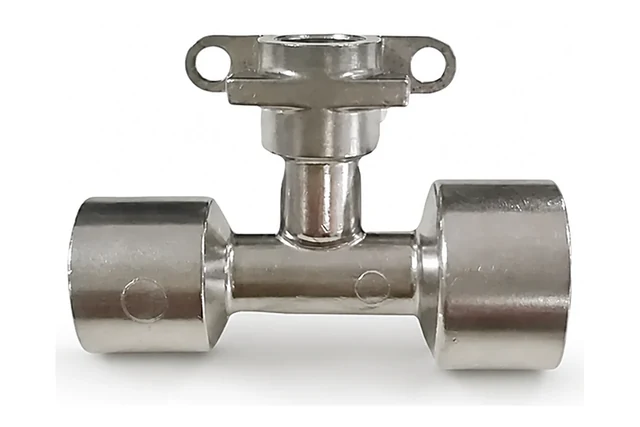
Valve-style geometry reference
This reference illustrates body, passage and moving-interface geometry. Supply scope follows the drawing.
Discuss a similar component →Metal component geometries for fluid-control and dispensing reviews, with attention to media exposure, fits and surface condition.
This reference illustrates body, passage and moving-interface geometry. Supply scope follows the drawing.
Discuss a similar component →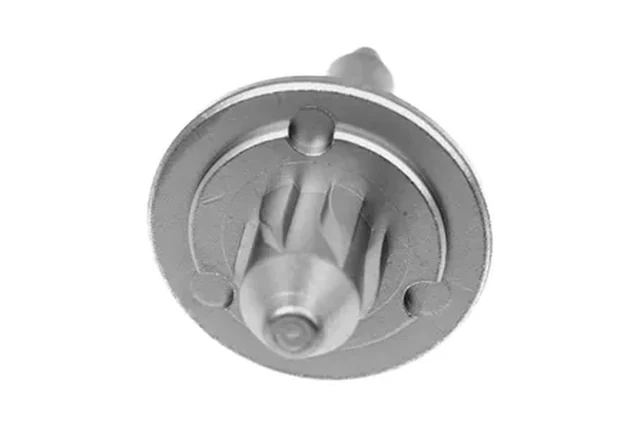
Used to discuss moving interfaces; not evidence of a qualified plunger or sealing component.
Discuss a similar component →Representative custom component references. Dimensions, material, manufacturing route and validation requirements are confirmed from your drawing; these are not off-the-shelf catalog items.
Seat carriers, cages, retainers and compact bodies where ports or integrated features can make near-net-shape production useful.
Reciprocating parts where straightness, sliding finish, impact, magnetic behavior or leakage can dominate the design.
Cams, levers, couplings and small gears that actuate metering or valve functions.
Small stainless parts exposed to beverage, adhesive, air or other media, with project-specific cleaning and compatibility requirements.
| Review area | Information to define | Manufacturing decision |
|---|---|---|
| Media & conditions | Fluid or gas, temperature, pressure, cleaning chemicals and exposure duration. | Confirm grade, corrosion and surface-treatment compatibility for the actual service. |
| Sealing interface | Mating seal, seat geometry, leakage criterion, surface finish and pressure-test method. | Plan critical-surface finishing and agree who performs component and assembly leak testing. |
| Motion & clearance | Stroke, guiding length, mating bore, cycle duty and contamination risk. | Review sliding fit, particle sensitivity and wear after finishing. |
| Cleanliness & scope | Particle limits, cleaning/packing requirements and any end-use documentation. | Confirm the component supply and validation plan; food-contact or pressure suitability is not inferred from shape. |
Material & final condition. Stainless grades may be candidates for corrosion-sensitive hardware. Material, porosity/density, surface finish and cleanliness are reviewed as a system. Machining remains part of the route where sealing or close sliding fits demand it. Review material data →
| Component / condition | First route to evaluate | Why / watchout |
|---|---|---|
| Feature-rich valve carrier / cage | MIM + critical finishing | 3D ports and integrated geometry may favor MIM; sealing bores/faces still require functional finishing. |
| Simple cylindrical plunger / stem | Turning / grinding | Axisymmetric precision motion and sealing surfaces usually favor machining. |
| Small actuation lever / cam | MIM or CNC | Complexity and repeat volume can favor MIM; contact profile and wear still need validation. |
| Micro nozzle / precision orifice | Micro-machining / EDM / laser | Do not default to MIM; hole geometry, roughness, concentricity and erosion can dominate performance. |
| Large manifold / valve body | CNC / casting / forging | Size, flow paths and finishing economics often make other processes more natural. |
Boundary: a near-net-shape body does not eliminate precision finishing on sealing, sliding or metering surfaces. Food-contact or chemical-compatibility status is also program-specific.
Review geometry, material and volume, identify critical features and clarify the proposed tooling and secondary operations.
Define trial parts, dimensional checks, material confirmation and any customer-required functional approval.
Confirm the approved route, control plan, packaging and repeat-supply requirements for the program.
Armatures, plungers, seats and valve interfaces.
Application guide →Plungers, guides, metering and valve-adjacent hardware.
Application guide →Valve, linkage and corrosion-sensitive stainless hardware.
Application guide →Utility-transfer inserts and compact fluid/pneumatic interfaces.
Application guide →State media, pressure/temperature, mating seals, leakage or clearance targets, cleaning requirements, drawing and annual quantity.