
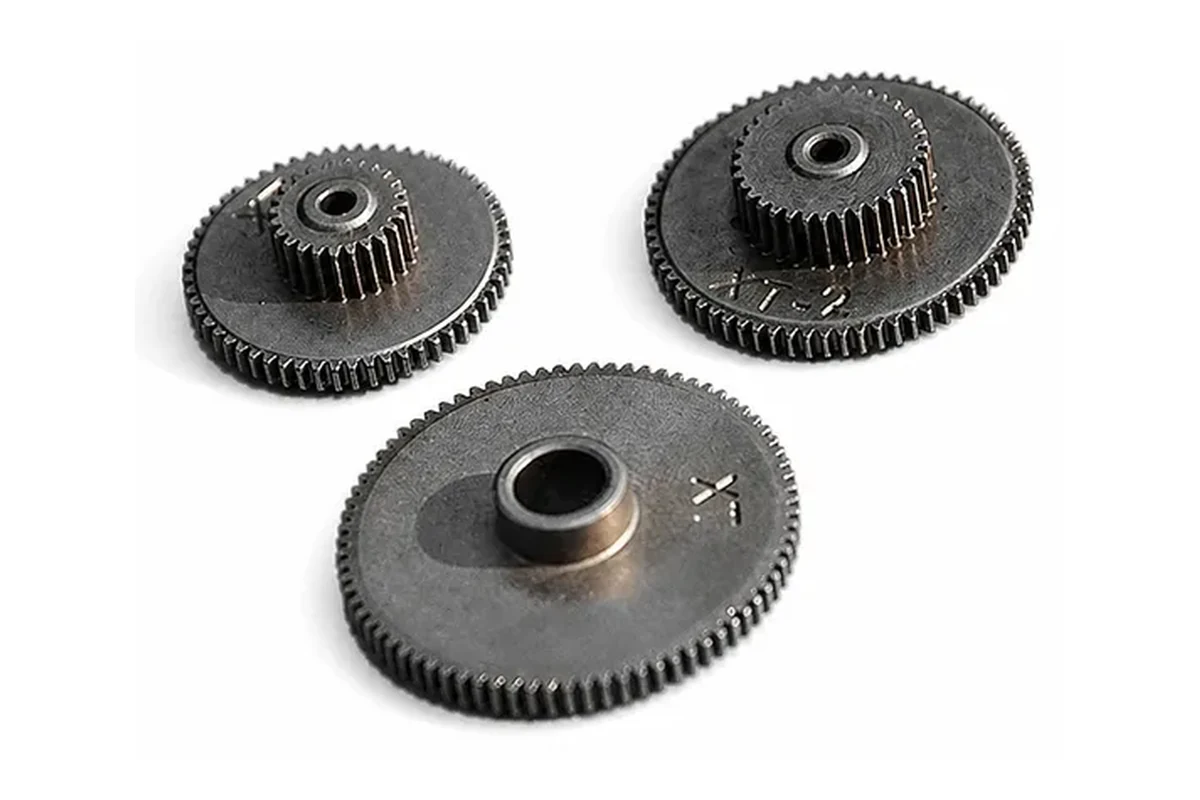
What spur and compound gear parts combine in one component
Review this component together with its mating parts and delivered condition. The interfaces below define the drawing information needed to assess forming, finishing and inspection.
Their tooth data and mounting datums must describe the same assembly relationship.
Tooth count, module, pressure angle and face-width interfaces
Specify tooth count, module or pitch, pressure angle, face width and any profile modification.
For compound gears, define the relative axes and positions of the stages.
Why do compound gears need a shared datum scheme?
Each stage interacts with a mating member, while the body links the stages through one mounting arrangement.
Defining the stages independently leaves that relationship incomplete.
Shared datums connect tooth requirements, axial positions and the common bore or shaft interface.
PM versus gear machining for tooth geometry
Compare PM and gear machining for the tooth geometry and volume.
Mounting bores, faces and any required tooth finishing should be identified as separate controlled operations.
The proposed route is confirmed for your drawing, material and quantity. An image does not establish a fixed tolerance or a complete process specification.
Compare manufacturing capabilities →Spur gear material, density and treatment requirements
Material and final condition must be reviewed against the defined load, wear, lubrication and environment.
Where powder processing is proposed, agree any relevant density and treatment requirements.
A material family or hardness value alone does not specify the gear or bearing duty.
Review material-selection information →Tooth geometry, bore fit and runout checks
Inspect tooth geometry, bore fit and face relationship, with any required runout or backlash check.
Include load, speed and lubrication in the engineering brief.
Specify the drawing revision and the condition in which each dimension is inspected. Record the agreed dimensional and functional checks before sample approval.
Quality documentation →Prepare a Product-Specific RFQ
- Component definition. Send the 2D drawing and 3D model, where available, with the drawing revision and the requested part or assembly scope.
- Mating information. Include the assembly references needed to define the interfaces discussed above.
- Delivered condition. State material, finishing and inspection requirements, identifying any items that need a manufacturing recommendation.
- Supply plan. Include sample needs, expected order and annual quantities, packaging requirements and target timing.
Product Questions
Can a compound gear be specified as two unrelated gear stages?
No. The relationship between stages and their common mounting features is part of the functional specification.
Why do compound gears need a shared datum scheme?
Each stage interacts with a mating member, while the body links the stages through one mounting arrangement. Defining the stages independently leaves that relationship incomplete. Shared datums connect tooth requirements, axial positions and the common bore or shaft interface.
Which checks should be included in gear or support approval?
Inspect tooth geometry, bore fit and face relationship, with any required runout or backlash check. Include load, speed and lubrication in the engineering brief.
Technical Context
The product-specific notes above identify drawing-review questions. General process and material references are collected separately; they do not verify a material grade, production qualification or performance claim for the pictured part.
Manufacturing and material references →Spur gear reference library
Component reference and drawing inputs
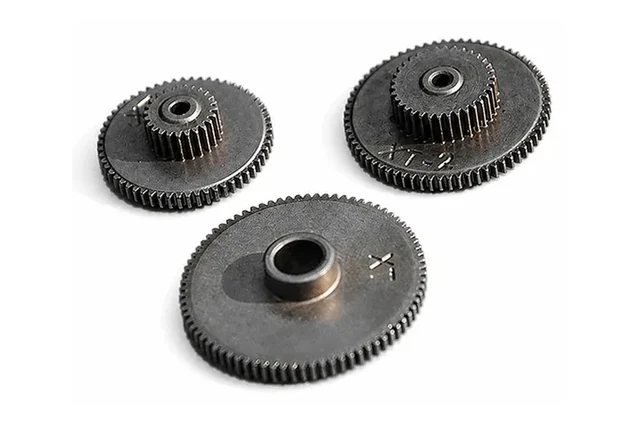
Spur gear forms
Define the functional datums, mating interfaces and final condition for this part.
Discuss a similar component →Representative custom component references. Dimensions, material, manufacturing route and validation requirements are confirmed from your drawing; these are not off-the-shelf catalog items.
Application, manufacturing and RFQ review
Use these points to prepare a review of a similar component. The illustration does not define a standard supply specification.
- Define tooth count, module or pitch, pressure angle and face width on the controlled drawing.
- Locate the bore, seating face and tooth inspection from agreed datums.
- Provide mating gear, duty and final material condition; identify proposed finishing.
Related guide: Powder Metallurgy Gears: What to Define Before Requesting a Quote
Submit your drawing for a manufacturing-route review →