
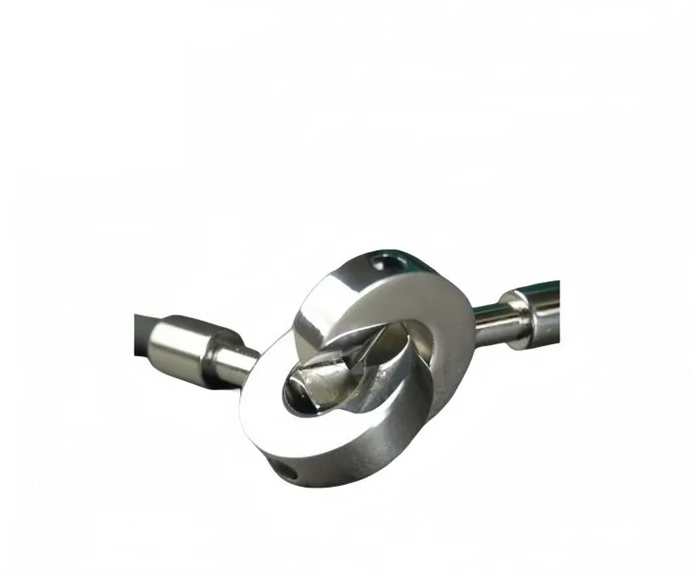
Why a titanium request needs an alloy-specific review
Review this component together with its mating parts and delivered condition. The interfaces below define the drawing information needed to assess forming, finishing and inspection.
The catalog reference provides an example form; it is not proof of a particular alloy or an approved process for a new drawing.
Functional surfaces and titanium-specification interfaces
Define functional surfaces and the required titanium specification before comparing routes.
Identify any section transitions, holes or interfaces that control the part in service.
Why is a material-specific process review necessary?
The selected alloy and required condition determine what must be controlled and documented.
A familiar shape does not make a processing plan transferable from another metal.
The project needs an explicit relationship between material specification, manufacturing steps and acceptance evidence.
Comparing machining and powder routes after alloy review
Compare machining with powder-based routes only after reviewing alloy availability, process compatibility and validation needs.
Do not apply a steel MIM process assumption to titanium.
The proposed route is confirmed for your drawing, material and quantity. An image does not establish a fixed tolerance or a complete process specification.
Compare manufacturing capabilities →Titanium alloy, property and documentation requirements
Specify the titanium alloy or the required material properties and documentation.
Confirm how final chemistry, condition and critical surfaces will be established for the proposed route.
Material appearance and a legacy catalog label cannot verify either an alloy grade or suitability for a particular application.
Review material-selection information →Material records, final condition and critical-geometry checks
Specify material records, final condition, critical geometry and any application-specific verification.
The approval plan should identify the evidence required for the selected route.
Specify the drawing revision and the condition in which each dimension is inspected. Record the agreed dimensional and functional checks before sample approval.
Quality documentation →Prepare a Product-Specific RFQ
- Component definition. Send the 2D drawing and 3D model, where available, with the drawing revision and the requested part or assembly scope.
- Mating information. Include the assembly references needed to define the interfaces discussed above.
- Delivered condition. State material, finishing and inspection requirements, identifying any items that need a manufacturing recommendation.
- Supply plan. Include sample needs, expected order and annual quantities, packaging requirements and target timing.
Product Questions
Can titanium use the same processing plan as stainless steel?
No. Material and processing compatibility must be assessed specifically for the selected titanium alloy and part.
Why is a material-specific process review necessary?
The selected alloy and required condition determine what must be controlled and documented. A familiar shape does not make a processing plan transferable from another metal. The project needs an explicit relationship between material specification, manufacturing steps and acceptance evidence.
What should the project acceptance plan include?
Specify material records, final condition, critical geometry and any application-specific verification. The approval plan should identify the evidence required for the selected route.
Technical Context
The product-specific notes above identify drawing-review questions. General process and material references are collected separately; they do not verify a material grade, production qualification or performance claim for the pictured part.
Manufacturing and material references →