
Material reference data
Grades and numerical properties below are taken from the current SINTS material list, including MIM steels, stainless steels, one magnetic alloy and a PM alloy entry.
Compare material grades and reference properties, then send your drawing and target condition for a project-specific review of material, manufacturing route and inspection requirements.
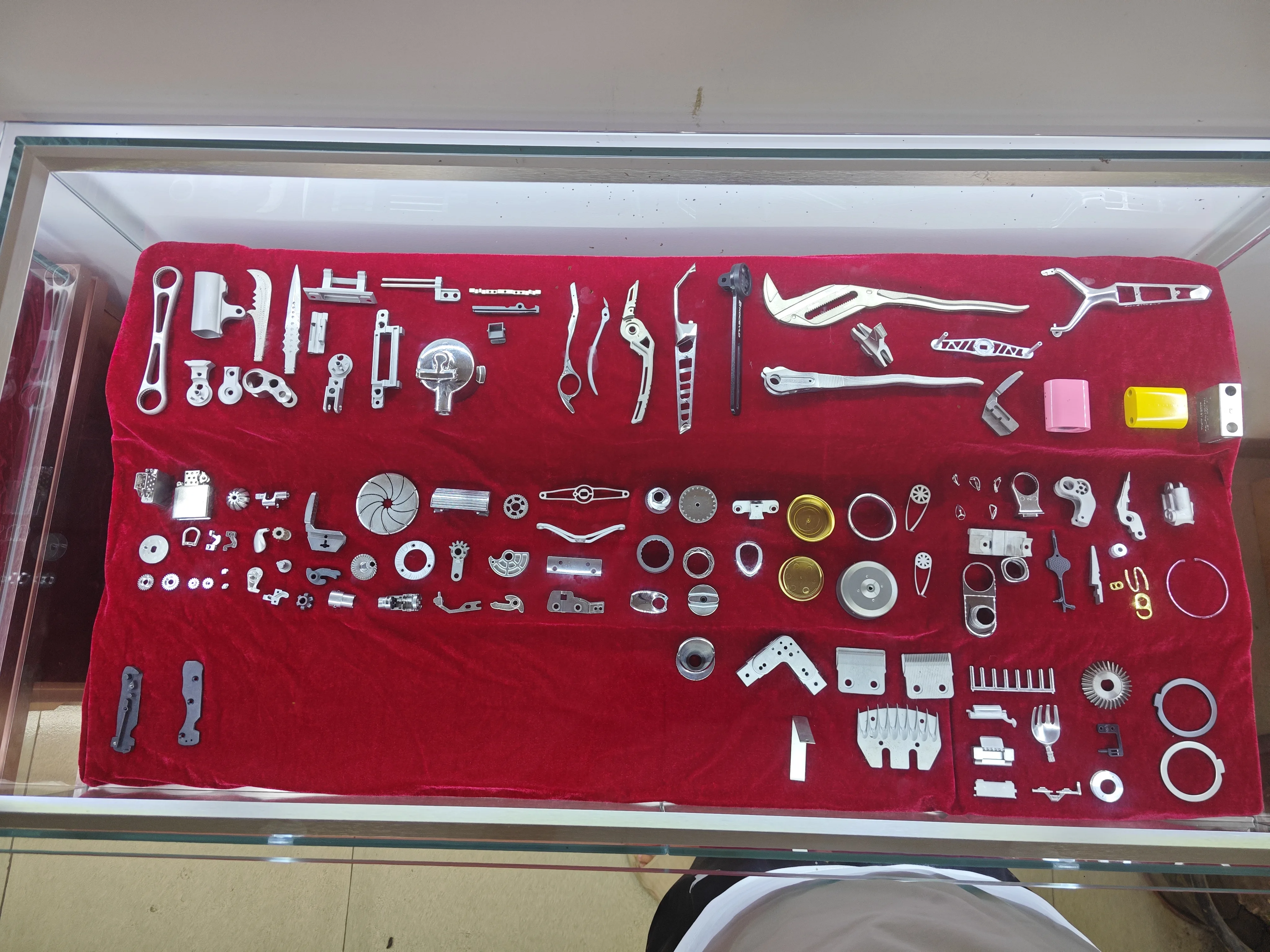
The tables below provide material reference data. Final grade, manufacturing route, heat treatment and acceptance criteria are agreed against your drawing and application before quotation.
Grades and numerical properties below are taken from the current SINTS material list, including MIM steels, stainless steels, one magnetic alloy and a PM alloy entry.
Titanium, aluminum, tungsten and copper material families are within SINTS project capability. Because exact grade, powder/feedstock or machining route, heat treatment and acceptance criteria vary by program, the specification is confirmed before quotation and tooling.
Heat-treatment condition, density, hardness and mechanical properties should be tied to the final drawing/specification and validated through the agreed sample and quality plan.
Standard references for these material families. The material families listed on this page correspond to published standards. MPIF Standard 35 is a set of material standards issued for different product families — structural parts, self-lubricating bearings, powder forged parts and metal injection moulded parts — and MPIF Standard 35-MIM — Materials Standards for Metal Injection Molded Parts is the relevant volume for MIM. ASTM B883-24 is the standard specification for metal injection moulded ferrous materials. ISO 5755:2022 is the current standard covering sintered metal material specifications. Stainless grades carry UNS numbers that make a specification unambiguous: 316L is UNS S31603 and 17-4PH is UNS S17400. Final material selection is confirmed against the application requirement for each project.
These values reproduce the current material sheet. Heat-treated rows are shown separately because the final condition changes strength and hardness substantially.
| Grade | Condition | Yield strength | UTS | Elongation | Hardness | Density |
|---|---|---|---|---|---|---|
| MIM 4605 (Fe-2Ni) | Sintered | ≥400 MPa | ≥600 MPa | ≥5% | ≥150 HV10 | ≥7.6 g/cm³ |
| MIM 4605 (Fe-2Ni) | Heat treated | 1425 MPa | 1610 MPa | 3% | 50–60 HRC | — |
| MIM 4140 | Sintered | 625 MPa | 825 MPa | 9% | 70–110 HRB | 7.6–7.8 g/cm³ |
| MIM 4140 | Heat treated | 820 MPa | 1405 MPa | 5% | 50–60 HRC | — |
Reference properties for SINTS stainless steel grades are listed below. Specify the exact grade and final condition when requesting a quotation.
| Grade | Condition | Yield strength | UTS | Elongation | Hardness | Density |
|---|---|---|---|---|---|---|
| MIM SS316L | Sintered | ≥180 MPa | ≥510 MPa | ≥50% | 120 HV10 | ≥7.6 g/cm³ |
| MIM SS316 | Sintered | 447 MPa | 732 MPa | 24% | 70–100 HRB | 7.6–7.8 g/cm³ |
| MIM SS304 | Sintered | 270 MPa | 480 MPa | 35% | 110–160 HV1 | 7.6–7.8 g/cm³ |
| MIM SS440C | Sintered | — | — | — | 30–40 HRB | 7.6–7.8 g/cm³ |
| MIM SS440C | Heat treated | 1150 MPa | 1310 MPa | 6% | 50–60 HRC | — |
| MIM SS420 / SS410 | Sintered | — | — | — | 30–40 HRB | 7.6–7.8 g/cm³ |
| MIM SS420 / SS410 | Heat treated | 1150 MPa | 1310 MPa | 6% | 40–50 HRC | — |
| MIM 17-4PH | Sintered | 720 MPa | 950 MPa | Confirm for project | 20–30 HRC | ≥7.6 g/cm³ |
| MIM 17-4PH | Heat treated | 1070 MPa | 1160 MPa | ≥5% | 35–45 HRC | — |
For as-sintered 17-4PH, confirm the required elongation with SINTS before using it in design calculations.
| Material | Process / condition | Yield strength | UTS | Elongation | Hardness | Density |
|---|---|---|---|---|---|---|
| MIM HK30 | Sintered | 463 MPa | 782 MPa | 18% | 160–250 HV1 | 7.6–7.8 g/cm³ |
| MIM FeSi 3.0 | Sintered | 372 MPa | 525 MPa | 23% | 80 HRB | 7.6–7.8 g/cm³ |
| FD-05N2C-360 (AB Powder) | PM · heat treated | 390 MPa | 540 MPa | 2% | 30–40 HRC | 6.6–6.9 g/cm³ |
Everything above is MIM, which sinters to 7.6 g/cm³ and above. A pressed-and-sintered part starts at 6.0 and stops near 7.4, and that gap is the material decision. A PM grade is chosen as a pair: the alloy class fixes the composition, the density fixes the properties. Put both on the drawing, or neither one is actually specified.
Designations follow MPIF Standard 35 and ISO 5755. FC-0205 is Fe–Cu–C — copper 1.5–3.9%, carbon 0.3–0.6%, balance iron — the general structural class, and the one most pressed parts use. FN-0208 is Fe–Ni–Cu–C, with nickel 1.0–3.0%, copper 0–2.5% and carbon 0.6–0.9%. The nickel is what buys impact resistance rather than just tensile strength. The number after the class is the strength level, and every level is reached at its own density: FC-0205-45 does not exist at 6.0 g/cm³, and a drawing that asks for it there is asking for a different part.
The minimum is the floor a purchase order is written against — MPIF Standard 35 sets it and no lot may fall below it. The tested column is what production runs actually return at that density, and across every grade in this table it lands seven to ten percent above the minimum. That gap is the margin you are buying, and it is normal rather than exceptional.
| Grade | Sintered density | Min tensile strength | Typical as tested | Min elongation | Normally used for |
|---|---|---|---|---|---|
| FC-0205-30 | 6.0 g/cm³ | 240 MPa | 263 MPa | 1.0% | Covers, brackets and light structural parts |
| FC-0205-35 | 6.3 g/cm³ | 280 MPa | 305 MPa | 1.0% | General brackets, housings, levers |
| FC-0205-40 | 6.7 g/cm³ | 340 MPa | 369 MPa | 1.0% | Load-bearing brackets, sprocket bodies |
| FC-0205-45 | 7.1 g/cm³ | 410 MPa | 439 MPa | 1.0% | Bushings, hubs, higher-load structural parts |
| FN-0208-30 | 6.7 g/cm³ | 310 MPa | 341 MPa | 1.5% | Shock-loaded brackets and linkage |
| FN-0208-35 | 6.9 g/cm³ | 380 MPa | 416 MPa | 1.5% | Linkage arms, latch parts |
| FN-0208-40 | 7.1 g/cm³ | 480 MPa | 523 MPa | 2.0% | Cams, non-critical gears |
| FN-0208-45 | 7.3 g/cm³ | 550 MPa | 596 MPa | 2.5% | Gears, sprockets, connecting parts |
| FN-0208-50 | 7.4 g/cm³ | 620 MPa | 668 MPa | 3.0% | Loaded gears, hubs, pawls |
The same two classes after quench and temper. Strength roughly doubles and elongation collapses; that trade is the whole reason the heat-treat call is a drawing decision rather than a finishing detail. The seven-to-ten percent margin between minimum and tested holds here as well.
| Grade | Sintered density | Min tensile strength | Typical as tested | Min elongation | Normally used for |
|---|---|---|---|---|---|
| FC-0205 · 60HT | 6.2 g/cm³ | 480 MPa | 525 MPa | 0.5% | Wear surfaces on a copper steel |
| FC-0205 · 70HT | 6.5 g/cm³ | 550 MPa | 598 MPa | 0.5% | Latch and cam surfaces |
| FC-0205 · 80HT | 6.8 g/cm³ | 620 MPa | 670 MPa | 0.5% | Loaded latches, striking parts |
| FC-0205 · 90HT | 7.0 g/cm³ | 690 MPa | 741 MPa | 0.5% | High-load wear parts without nickel |
| FN-0208 · 80HT | 6.7 g/cm³ | 620 MPa | 682 MPa | 0.5% | Heat-treated gears, pawls |
| FN-0208 · 105HT | 6.9 g/cm³ | 830 MPa | — | 0.5% | Transmission gears, ratchet parts |
| FN-0208 · 130HT | 7.0 g/cm³ | 1000 MPa | 1085 MPa | 0.5% | High-torque gears and cams |
| FN-0208 · 155HT | 7.2 g/cm³ | 1170 MPa | 1263 MPa | 0.5% | Highly loaded transmission parts |
| FN-0208 · 180HT | 7.4 g/cm³ | 1340 MPa | 1440 MPa | 0.5% | Maximum strength for a pressed part |
Where the numbers come from. Minimums are MPIF Standard 35 floors. Tested values are production typicals from this press-and-sinter route, not guaranteed limits on any individual lot — a purchase order is written against the drawing and the agreed specification, not against this table. One value in the heat-treated FN-0208 group does not follow its own grade sequence and is withheld rather than republished; the minimum shown for that level still applies.
Between 6.0 and 7.4 g/cm³ the same powder delivers 240 to 620 MPa before any heat treatment, and elongation from 1.0% to 3.0%. A drawing that says only "sintered steel" has named a family, not a material. Naming the class and the density is what makes two quotations comparable — otherwise every supplier quotes a different part.
At the same 620 MPa, FC-0205-90HT gives 0.5% elongation and FN-0208-50 gives 3.0% — six times the strain before fracture. On a part that sees impact, a drop or a press fit, that difference decides the failure mode. It is paid for in nickel rather than in a thicker section.
FN-0208-50 sits at 620 MPa and 3.0% as sintered; the same class at 180HT reaches 1340 MPa at 0.5%. That is a real 2× gain and a 6× loss of ductility in a single step. The question is not whether to heat treat, but which failure the part has to survive first.
Do not copy the tested column into the drawing. A typical is what most lots reach; a minimum is what no lot may miss. Writing 670 MPa onto a drawing whose grade floor is 620 does not buy margin — it moves the part to a higher density or a different class, and the price moves with it. Specify the minimum the function needs, then confirm the typical on the first article.
What these tables do not tell you. Fatigue strength, wear rate, dimensional tolerance and corrosion resistance are not in them, and none of the four follows from tensile strength alone. Density also sets porosity — the same porosity that makes a PM part oil-retaining and self-damping is what makes it notch-sensitive. On a gear, a latch or a bearing the working density is usually fixed by a functional test, not by the tensile column. That is why the RFQ asks what the part does, not only what it must withstand.
The tables above answer "how strong". This one answers the three questions that usually pick the grade first: how long it lasts in neutral salt spray, what it takes to sinter it, and where it is normally used. Mechanical values are deliberately left out here because they are already listed above.
| Grade | Route / condition | Sintering temperature | Neutral salt spray | After passivation | Typical applications |
|---|---|---|---|---|---|
| 316L | PM / MIM · sintered | 1360–1400 °C | 72–120 h | 200–500 h | Medical instruments, food machinery, marine hardware |
| 316 | PM / MIM · sintered | 1360–1400 °C | 48–72 h | 120–168 h | Chemical equipment, seawater handling, valves |
| 304 | PM / MIM · sintered | 1150–1300 °C | 48–72 h | 120–168 h | Food processing, cookware, appliance housings |
| 420 | PM / MIM · heat treated | 1200–1300 °C | 20–40 h | 200–400 h | Cutting edges, surgical instruments, bearing parts |
| 440C | PM / MIM · sintered, martensitic | 1230–1240 °C | 24 h | 48–72 h | Blades, bearings, nozzles, coffee grinder burrs |
| 17-4PH | PM / MIM · sintered | 1320–1360 °C | Not stated | 144 h | Aerospace, oil and gas, medical instruments |
| 4600 (Fe-8Ni) | PM · sintered or heat treated | 1340–1400 °C | n/a * | n/a * | Structural parts, automotive, hand tools |
| 4605 (Fe-2Ni) | PM / MIM · sintered or heat treated | Not stated | n/a * | n/a * | Structural parts, power tools, appliances |
| 4140 | PM / MIM · sintered or heat treated | 1200–1250 °C | n/a * | n/a * | Gears, shafts, high-strength fasteners |
| Ti-6Al-4V (TC4) | PM · sintered | 1250–1350 °C | 500 h | >1000 h | Aerospace, implants, marine |
| 6061 (AlSi10Mg) | PM · sintered | 500–600 °C | 24–72 h | 24–72 h | Lightweighting, electronics, heat sinks |
| ZAMAK 3 (ZnAl4) | Die casting | 380–430 °C | n/a * | n/a * | Fittings, decorative parts, handles |
| T2 (C11000) | PM · sintered | 930–1050 °C | >500 h | n/a * | Electrical parts, heat sinks, seals |
How to read this table. Salt-spray hours are reference values from the SINTS material summary, listed as ranges because they depend on density, surface preparation and test duration. * Low-alloy, zinc and copper grade rows are marked n/a because their salt-spray performance is a function of the applied coating or oil rather than the base material. HK30, FeSi 3.0 and FD-05N2C-360 are documented in the mechanical tables above but carry no salt-spray reference data. The required test standard, duration and acceptance level always come from your drawing, not from this page.
Corrosion hours and cost bands are only useful if they change a decision. These are the three decisions they change most often.
Neutral salt spray runs 48–72 h for 304 against 72–120 h for 316L; after passivation, 120–168 h against 200–500 h. If the part sees road salt, wash-down or marine air, the extra hours are usually cheaper than adding a coating line. If it sees only indoor humidity, 304 is the honest answer.
420 moves from 20–40 h to 200–400 h, which is a five- to ten-fold change from a finishing step that does not touch geometry. That is why "specify a better alloy" is often the wrong first move: fix the finishing route, then see which alloy is actually still needed.
Accelerated salt spray ranks materials against each other; it does not predict service life. Chloride concentration, temperature, stress and crevices all intervene. Use this table to shortlist the grade, then put the acceptance test and its duration on the drawing.
Feedstock cost bands. Grades group roughly into four relative feedstock bands: 4605 / 4600 / ZAMAK 3 lowest; 4140 / 420 / 304 / 6061 next; 316 / 316L / 440C / T2 / 17-4PH above those; Ti-6Al-4V in a band of its own, because titanium feedstock also brings atmosphere control and oxygen pickup limits with it. These are qualitative bands from SINTS purchasing, not a price. On small parts the piece price is decided far more by tooling amortisation and secondary operations than by the powder — the flanged threaded bushing review shows how that works on a real drawing.
SINTS evaluates titanium, aluminum, tungsten and copper alloy components from the required properties, drawing and volume. The exact grade, manufacturing route and validation plan are confirmed for each project.
Projects are reviewed from the exact alloy, geometry, contamination or surface requirements, volume and critical dimensions before SINTS confirms the practical manufacturing route.
Projects are reviewed from alloy, density or mechanical-property targets, geometry, corrosion or finish requirements and volume before the manufacturing route is confirmed.
Projects are reviewed from the exact material system, density or property targets, geometry, wear requirements and production route before quotation.
Projects are reviewed from conductivity, strength, density, finish, geometry and process requirements before quotation.
Send the exact grade or material family, drawing, annual volume, target condition and critical properties. SINTS will confirm whether the material and manufacturing route can be supported before tooling.
Load, wear, corrosion, temperature, magnetic response, fatigue and contact conditions.
Wall thickness, feature complexity, pressing direction, sintering distortion risk and critical datums.
Annual demand affects whether MIM/PM tooling is justified or machining remains more practical.
Heat treatment, hardness, surface finish, coating and post-sinter machining requirements.
Agree on the sample, dimensional, material and functional checks before serial production.
Define which certificates, inspection data and project-specific reports are actually required by the OEM.
Answers based on the current SINTS material sheet and project-review approach.
The listed stainless grades include 316L, 316, 304, 440C, 420/410 and 17-4PH. Specify the required grade and final condition for your project.
MIM 4605 (Fe-2Ni) and MIM 4140 are listed in both sintered and heat-treated conditions.
Yes. The current material sheet lists MIM FeSi 3.0 in the sintered condition with yield, tensile, elongation, hardness and density values.
Yes. Titanium-alloy components are within SINTS project capability. The exact alloy, manufacturing route, property targets and validation requirements are confirmed from the drawing and application.
Yes. SINTS can support aluminum-alloy component programs. The exact alloy and whether PM, machining or another route is appropriate are confirmed project by project.
Yes, additional materials can be evaluated. Material availability, manufacturing route and target properties must be agreed for the specific project.
Reference values are 316L 72–120 h, 316 and 304 48–72 h, 420 20–40 h and 440C 24 h in neutral salt spray. After passivation the same grades are quoted at 316L 200–500 h, 316 and 304 120–168 h, 420 200–400 h and 17-4PH 144 h. These are comparative reference ranges; the acceptance test and duration for a project come from the drawing.
It depends on chloride exposure rather than on preference. 316L roughly doubles the reference salt-spray hours of 304, and after passivation the gap is wider still. For road salt, wash-down or marine air, 316L is usually cheaper than adding a coating line. For dry indoor parts, 304 is the appropriate grade and the extra cost buys nothing.
Yes, because it sets what density and microstructure the process can reach. The documented ranges differ by grade — 304 is listed at 1150–1300 °C while 316L is 1360–1400 °C — so the grade choice changes the thermal cycle, and the thermal cycle changes the achievable density. That is why material and process are selected together rather than in sequence.