
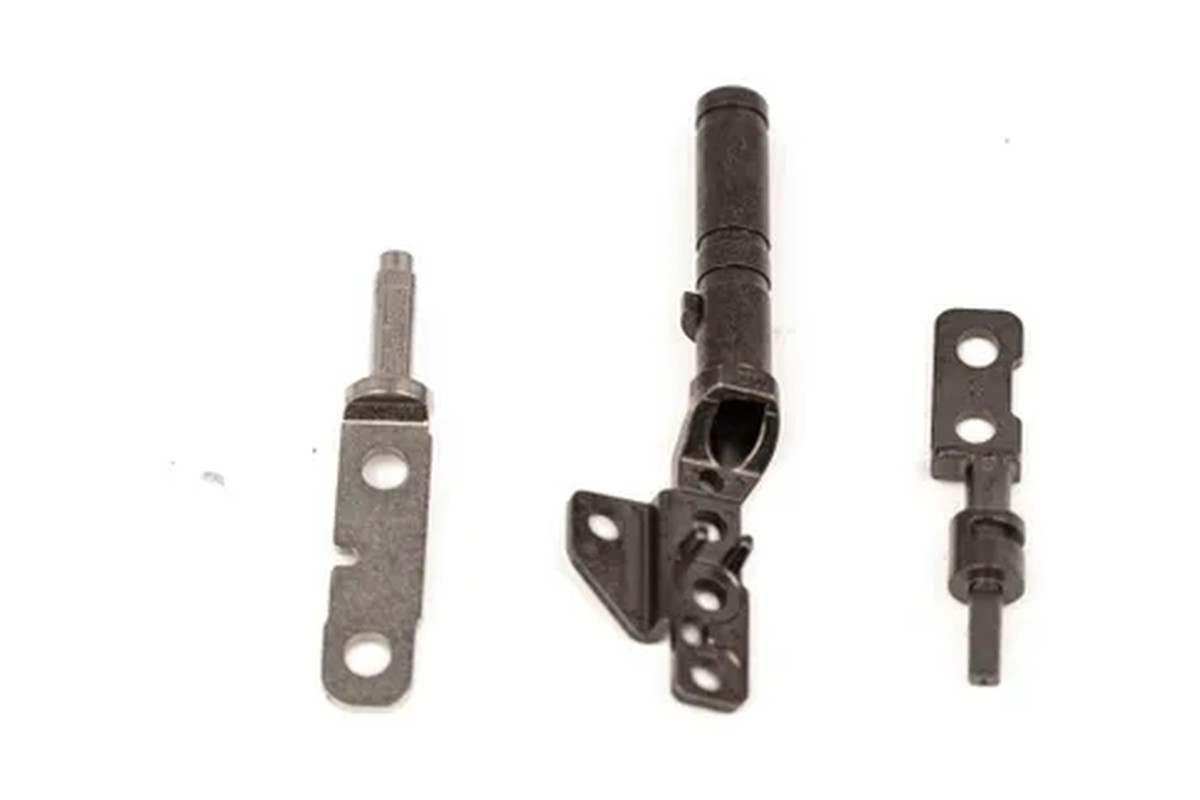
The customer, part number and all commercial figures have been withheld. Mass, material, condition, hardness, finishing and quantities below are as stated on the quotation record; the route commentary is SINTS engineering assessment for this part.
The part, as quoted
It is a precision structural component of about 1.2 g, moulded, sintered, aged and finished. Nothing in that sentence is unusual for MIM; the interesting content is in the two lines that describe what happens after sintering, and in the quantities that make a tool worth cutting.
| Field | As quoted | Why it decides something |
|---|---|---|
| Material | 17-4PH stainless | Martensitic precipitation-hardening grade, chromium-nickel-copper. Hardens by an aging treatment rather than by a quench-and-temper cycle, which is what makes it compatible with a sintered part. |
| Mass | Approx. 1.2 g | Small section, fast thermal response. Everything about the heat treatment happens quickly and unevenly unless the load and the ramp are controlled. |
| Condition | H1025 aged | The aging temperature in Fahrenheit, 1025 °F, roughly 550 °C. It sets strength, hardness and ductility together as one package. |
| Hardness | HRC 35-42 | The acceptance figure. It is a consequence of the condition, not an independent requirement — which matters when the two appear to disagree. |
| Surface | Passivation, ultrasonic cleaning | Passivation restores the oxide layer after finishing; ultrasonic cleaning is what reaches the features a 1.2 g part can have and a cloth cannot. |
| Process route | MIM → precision post-machining | Only the dimensions that cannot be held as-sintered are machined. Everything else is bought from the tool. |
| Order quantity | MOQ 5,000 pcs, 2,000 to start | Same commercial frame as the other parts in this batch: tooling is the fixed cost, and a 2,000-piece start is what makes a first order possible. |
| Tooling and samples | 25-30 days tooling, 7-10 days samples | Quoted for this part, not a published lead time. The sample gate is where the aging condition and the distortion question get answered. |
Why 17-4PH rather than 316L
Most stainless MIM components are 316L, and for good reason: it is the most forgiving alloy in the catalogue, it welds, it passivates well, and its ductility means the design does not have to be very careful about stress concentration. It also cannot be strengthened by heat treatment. What comes out of the sintering furnace is what the part is, mechanically, for the rest of its life.
17-4PH is the answer when the part has to carry load. In the aged condition the reference data gives it around 1070 MPa yield against 250 MPa for sintered 316L — a factor of four — with hardness in the mid-to-high thirties on the Rockwell C scale. That is a different class of component, and it is bought deliberately.
| Alloy | Condition | Yield MPa | Tensile MPa | Elong. % | Hardness | Density | Salt spray |
|---|---|---|---|---|---|---|---|
| 17-4PH | Sintered | 720 | 900 | 11 | 20-25 HRC | 7.5 g/cm³ | — |
| 17-4PH | Heat treated (H1025 class) | 1070 | 1160 | 7 | 35-45 HRC | — | 144 h passivated |
| 316L | Sintered | 250 | 498 | 40 | 110-160 HV | 7.75 g/cm³ | 72-120 h |
| 420 | Heat treated | 1150 | 1310 | 6 | 40-45 HRC | 7.4 g/cm³ | 20-40 h |
Values are SINTS reference ranges for the listed conditions, taken from our material reference data. They are typical values for comparing alloys, not design allowables and not acceptance criteria for this part. Density is not quoted for the aged condition because aging changes structure, not the sintered density the part was built to.
Two things are worth noticing in that table. The first is the elongation column: 40% down to 7%. That is the actual price of the strength, and it shows up in design as a reduced tolerance for stress raisers — sharp internal corners, abrupt section changes, thread roots. The second is corrosion. 17-4PH is not a 316L substitute on corrosion, and the reference data has no plain-condition salt-spray figure for it at all; the performance it does have is the passivated figure. On a part that will see chlorides, that distinction is the whole conversation.
H1025 is a temperature, and the H-number is the specification
Precipitation hardening works differently from quench-and-temper. The alloy is solution treated at high temperature so the strengthening elements — copper in this case — go into solid solution, then cooled quickly enough to keep them there. The result is soft and workable. Aging then holds the part at a moderate temperature long enough for fine precipitates to form, and it is those precipitates that carry the load. The aging temperature is the control: hotter for longer gives coarser precipitates, lower strength, more ductility; cooler gives finer precipitates, higher strength, less ductility.
| Condition | Aging temperature | Strength | Ductility | When it is the right choice |
|---|---|---|---|---|
| H900 | 900 °F / approx. 480 °C | Highest of the common conditions | Lowest | Maximum strength with a geometry that has no stress raisers and no thin-to-thick transitions to worry about. |
| H1025 | 1025 °F / approx. 550 °C | High | Moderate | The quoted condition. The usual compromise where the part has to be strong and still survive handling, assembly and edge loading. |
| H1150 | 1150 °F / approx. 620 °C | Lowest of the three | Highest | Where toughness or dimensional stability matters more than strength, or where the part will be machined after aging. |
Which is why "H1025" on a drawing is a stronger instruction than "HRC 35-42" beside it. The hardness is an outcome. If a drawing carries both and they ever disagree — a different alloy heat, a different furnace, a longer soak — the H-number is the requirement and the hardness is the check. Reading it the other way round produces a part that passes inspection and is not the part that was designed.
The step that actually decides whether H1025 works
The aging treatment can only act on a part that is still in the solution-treated condition. In MIM that condition is created upstream: the part is sintered at around 1320-1360 °C, which is also high enough to solution treat the alloy, and then it has to cool fast enough that the copper stays in solution on the way down. Cool slowly through the intermediate range and the precipitates form there instead — coarser, uncontrolled, and no longer available to be re-formed by the aging cycle. The part then goes into the aging furnace already partly aged, and comes out under the specified hardness with no process variable left to fix it.
That is the reason the aging step cannot be treated as a purchased service appended to a MIM order. It is the second half of one thermal history, and the two halves have to be specified together: sintering temperature, cooling rate out of the furnace, aging temperature, soak and atmosphere. On a 0.4 g or 1.2 g part the thermal mass is small enough that the cooling rate is largely set by the furnace and the load arrangement rather than by the part, which is good for repeatability and bad for intuition — the part does not cool the way its size suggests.
1.2 grams, HRC 35-42, and where the distortion lands
Aging is a dimensional event. The precipitate that strengthens the alloy occupies slightly less volume than the matrix it forms in, so an aged part is marginally smaller than the same part before aging. On a large component this is a design allowance. On a 1.2 g part with features measured in tens of microns, it is a tolerance line item, and it arrives at the worst possible moment — after the tool is cut and after the as-sintered dimensions have been approved.
There are only three honest ways to deal with it, and the quotation implies which one applies:
- Grind after aging. The dimension is created after the last thermal event, so it cannot drift. This is what "precision post-machining" after the aging step is doing in the route.
- Qualify the aging step first, then cut the tool to compensate. Cheaper per piece, but it moves the risk into the tool and requires a first article through the full thermal cycle before the tool is frozen.
- Split the tolerance. Hold the non-critical dimensions as-sintered, and reserve a small allowance on the ones that must not move. This only works if the drawing says which is which.
Hardness measurement on a part this size belongs to the same conversation. HRC 35-42 read on a thin flange, on a curved surface or next to a section change is not the same number as HRC 35-42 read on a sound, flat, thick-enough surface. Whether the check is done on the part, on a witness coupon from the same sintered lot, or by micro-indentation is a decision that has to be agreed before the first article, because the three do not agree with each other.
Ferromagnetism: the property that is not on the drawing
17-4PH in the aged condition is ferromagnetic. 316L is austenitic and, in practice, non-magnetic. This is not a subtle metallurgical footnote; it is a difference a magnet finds in one second, and it decides several things that a drawing usually does not mention.
| Situation | 17-4PH aged | 316L |
|---|---|---|
| Hall-effect or magnetic sensor nearby | Part is part of the magnetic circuit. Position sensing may work, or may be swamped, depending on geometry and gap. | Largely transparent to the field. Usually the reason 316L is chosen for sensor-adjacent hardware. |
| Magnetic particle inspection | Applicable — the alloy will carry flux, so surface and near-surface defects can be found this way. | Not applicable in practice. Inspection has to move to penetrant or another method. |
| Retention in an assembly | Can be held magnetically during handling and fixturing; a design opportunity and a contamination risk at the same time. | Needs mechanical retention throughout. |
| Loose part in a mechanism | A stray fragment will stick to magnets, sensors and steel surfaces inside the product. | Fragment stays where it fell, which is often preferable in clean assemblies. |
None of this makes 17-4PH the wrong choice here — the part needs the strength, and the strength is the point. It does mean that "non-magnetic" is a requirement that has to be written down when it applies, and that a substitution between the two alloys is a functional change rather than an equivalent-material swap. The same reasoning applies to any substitution proposed during a cost review, which is why the alloy decision is worth settling before tooling rather than after.
The questions a quotation like this has to send back
| Question | Why it is not a detail | What the answer changes |
|---|---|---|
| What drives the requirement — strength or hardness? | H1025 delivers both, but they are checked differently and a "hardness only" requirement can be met by more than one condition. | Decides whether the condition is fixed or the hardness is the acceptance criterion, and therefore what the heat-treat lot is released against. |
| Where and how is hardness measured? | On a 1.2 g part, surface condition and section thickness change the reading more than the heat treatment does. | Sets the inspection method, the fixture, and whether a witness coupon is acceptable evidence. |
| Which features must not move after aging? | The route can grind them afterwards, or the tool can be cut to compensate — but not both by accident. | Changes the sequence of machining and the tool dimensions, and therefore the first-article plan. |
| Corrosion requirement and test condition | Not stated on the record. 17-4PH's reference data only carries a passivated figure. | Fixes passivation chemistry and acceptance, and whether salt spray is a lot release criterion. |
| Is the part allowed to be magnetic? | If it sits near a sensor or a magnet, this is a function, not a property. | Rules the alloy in or out, and rules out equivalent-material substitution later. |
| Maximum service temperature | Aging is a precipitation structure, and structures coarsen with temperature over time. | Determines whether H1025 is still the right condition at operating temperature, or whether the part should be over-designed now. |
| Cleaning and particle specification | Ultrasonic cleaning is quoted; the acceptance level for residual particles is a separate requirement. | Sets the cleaning cycle, the inspection and the packaging — which on a small part is where contamination usually enters. |
| Surface roughness, and where it applies | As-sintered, machined and passivated surfaces are three different finishes. | Separates machining time from finishing time, and defines what the drawing actually controls. |
What the quotation covers, and what it does not
It covers MIM to near-net shape, precision post-machining on the dimensions that need it, aging to the H1025 condition with the stated hardness window, passivation and ultrasonic cleaning — with tooling at 25-30 days and samples at 7-10 days after tooling approval, quoted for this part rather than offered as a standard lead time. Order quantity is 5,000 pieces with 2,000 accepted to start.
What it does not contain: an application, a yield figure, an achieved cost or a delivery record. It is a quotation on a real component, not a completed production programme. The alloy, the condition and the finishing sequence are the customer's requirements; the reading of what they imply — including the cooling-rate dependency and the magnetic consequence — is ours.
Two things this note is not. It is not a claim that MIM replaced another process for this part, and it is not a material qualification. The alloy comparison draws on the SINTS material reference data; the acceptance values for this part belong to this specification and are confirmed through the agreed sample and inspection plan. Where the reference data carries no figure — as with unpassivated 17-4PH salt spray — none is asserted here.
What to send for a review like this
For an aged alloy the useful package is the model, the condition with what drives it, the features that must not move after the last thermal step, and the corrosion requirement with its test condition. Add whether the part is allowed to be magnetic. That last one is a single word, and it decides more of the answer than most of the drawing does.